
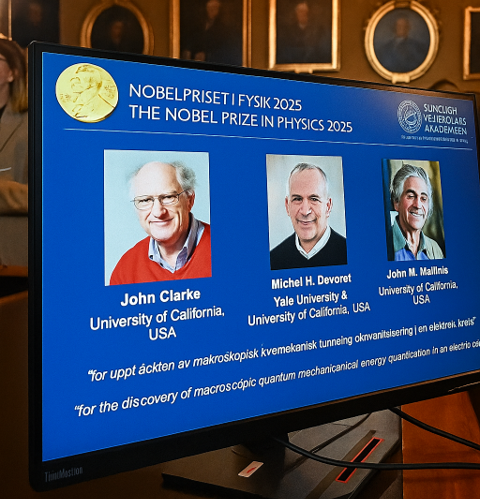
John Clarke, Michel Devoret, and John Martinis won the 2025 Nobel Prize in Physics for their work on superconducting circuits, which demonstrated quantum mechanical behavior on a macroscopic scale.
- Their experiments have helped lay the foundation for today’s quantum technologies: computers, sensors, and secure communications.
- This award underscores how quantum mechanics is not just theoretical — it’s becoming deeply practical.
Nobel Prize in Chemistry — MOFs to Tackle CO₂ & Water Scarcity
The 2025 Nobel Prize in Chemistry was awarded to Susumu Kitagawa, Richard Robson, and Omar M. Yaghi for their development of metal-organic frameworks (MOFs).
- MOFs are porous structures that can trap gases or liquids — the laureates’ work opens possibilities for removing CO₂ from the atmosphere.
- They can also be used to harvest water in arid regions, potentially turning desert air into usable water.
- Beyond environment, MOFs have other applications: gas storage, drug delivery, and more.
Google Claims Quantum Advantage for Drug Discovery
Google announced it has achieved a “quantum advantage” using a new algorithm called Quantum Echoes.
- According to Google, their quantum processor can simulate molecular interactions ~13,000× faster than classical supercomputers.
- This could accelerate drug discovery, allowing faster design of molecules for medicines.
- The results are reportedly verifiable, which is a big deal for trust in quantum-computed simulations.
Massive Biodiversity Bank Opens in Australia
The CSIRO (Australia’s national science agency) launched a huge biodiversity vault — storing more than 13 million specimens: insects, birds, plants, and more.
- This “Diversity” bank is climate-controlled, disaster-resistant, and built to preserve specimens for decades.
- It will support environmental research, climate science, and even medical discovery, since some preserved venom samples could lead to new neurological drugs.
- The facility is also meant to help with zoonotic disease research: storing bats, insects, and other species that matter for understanding wildlife pathogens.
ScienceDaily Highlights — Key Research Breakthroughs
From ScienceDaily (mid-November 2025):
- Alzheimer’s Research: Tau proteins (linked to Alzheimer’s) first form soft, reversible clusters — dissolving these prevents harmful fibril growth.
- Rain-to-Electricity Generator: A floating device harvests energy from raindrops, using water itself as both structure and electrode.
- Diabetes Molecule: Scientists identified a small molecule that disrupts a harmful protein pair associated with inflammation in diabetes, helping wounds heal faster.
- Hidden Crater Discovered: A massive, well-preserved meteorite crater was found in southern China, reshaping what we know about recent geological history.
- Hypersonic Flight Physics: New turbulence research could help design aircraft capable of flying at 10× the speed of sound.
New Paper: Framework to Study Interstellar Objects
A white paper published on arXiv proposes creating an international body — UNCIO (United Nations Committee on Interstellar Objects) — to coordinate study of interstellar objects (ISOs).
- With new telescopes like the Rubin Observatory (LSST), detections of ISOs are expected to increase significantly.
- This committee would help harmonize global scientific response, observation, and even policy for studying these extraordinary objects.
- The goal: maximize scientific return from ISOs, including in astrobiology, fundamental physics, and materials science.